FunFare
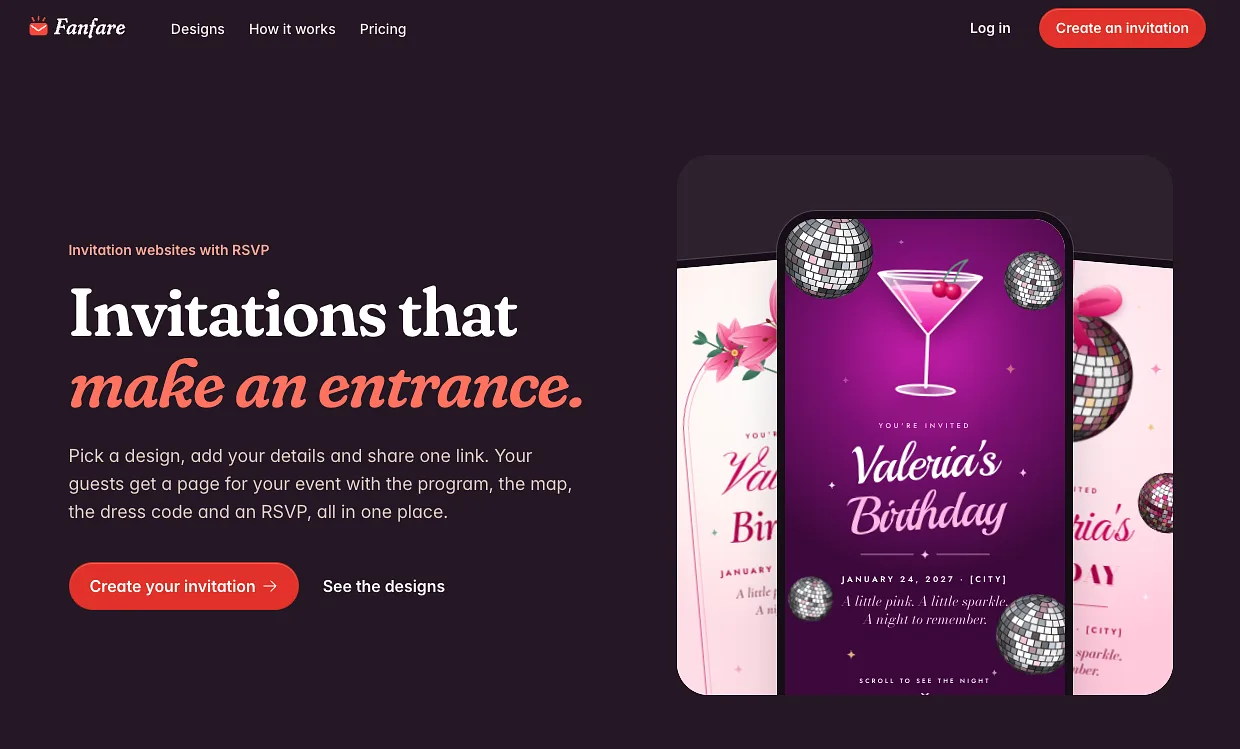
Fanfare is a SaaS app for turning party and wedding invitations into small, shareable websites. A host picks a design, such as Cocktail Hour, Pink Lilies or Disco Night, and fills in a guided 7-step editor. They then publish one private link. Guests open an animated envelope and see the full event page: a live countdown, the evening's timeline, venues with maps, the dress code with colour swatches, a menu and a gift list. Guests reply (RSVP) from their phone, choosing their name, which parts of the night they'll attend and their meal. The host's dashboard shows who's coming, companions, meal choices and messages. The app is fully bilingual (English and Spanish). Tech stack: Ruby on Rails 8, Hotwire (Turbo and Stimulus), ViewComponent, Tailwind CSS v4, PostgreSQL, Solid Queue, Active Storage, Pundit, the Interactor gem, Draper and Minitest.
- Many designs without many codebases. Every template needed its own look while keeping the same features, and adding a new design had to stay cheap. -Mobile-first guest experience. Most guests open the link on a phone, so the page had to be fast, readable and pleasant there, including the envelope-opening animation and scroll position. Heavy media from hosts. Hosts upload large phone photos and songs, which would make the guest page slow. - Correct dates and times across time zones. An event at "20:00 in Madrid" has to show and count down correctly wherever the guest is. - Guest replies that stay valid. RSVPs must only accept names on the guest list, parts of the night that exist, and meals on the menu, with no duplicate replies. - Two languages everywhere. The host's dashboard follows the host's language, while each guest page uses the invitation's own language.
- Shared sections, different themes. Each page section is one reusable component. A design is only a theme: a colour palette, illustrations and typography set through CSS variables. Adding a new template means adding one theme class. - Clear layers. Controllers stay thin. Business steps such as publish, duplicate and optimise media are single-purpose classes, permissions are checked with Pundit policies, and display logic lives in decorators. - Background media optimisation. Jobs re-encode photos to WebP and long songs to 128 kbps MP3, and pre-build image sizes. Database locks make swapping in the new file safe, and the original is kept for a day so pages already open don't break. - Time zones handled explicitly. The event time is stored exactly as the host typed it, together with its time zone, and converted only when shown. - Validation in the models. Guest replies are checked against the guest list, schedule and menu, and reply counts are kept up to date automatically. - Translation enforced by a test. A test fails if the English and Spanish text files drift apart. The app has 124 test files covering models, policies, components and full browser flows.
المشروع التالي